
Reviewed · CITY TOURS
Gondar city Tour With Airport & Hotel Pick Up
Gondar packs an imperial past into one day. This 7.5-hour city tour brings together Fasil Ghebbi, Fasilides Baths, Debre Birhan Selassie Church, and Wolleka, with an air-conditioned vehicle and airport or hotel pickup. I like the strong mix of castles and living religious culture, and I like that the small group is limited to 10 people. The main drawback is the pace: four major stops leave limited time for lingering or exploring Gondar on your own.
The $90 price is reasonable if you value door-to-door transport, entrance fees, a guide, and help after arriving at the airport. The tour begins at 9:00 am from Central Hotel, and the exact pickup arrangement is worth confirming if you are arriving by air. One especially useful detail comes from the operator’s handling of a past booking: Mickey arranged an airport welcome and connected the visitor with local guides who covered the city’s main sights.
In This Review
- Four details that shape the day
- Why Gondar deserves a full day
- Starting at Central Hotel at 9:00 am
- Fasil Ghebbi: two and a half hours among royal buildings
- Fasilides Baths and the annual Timkat connection
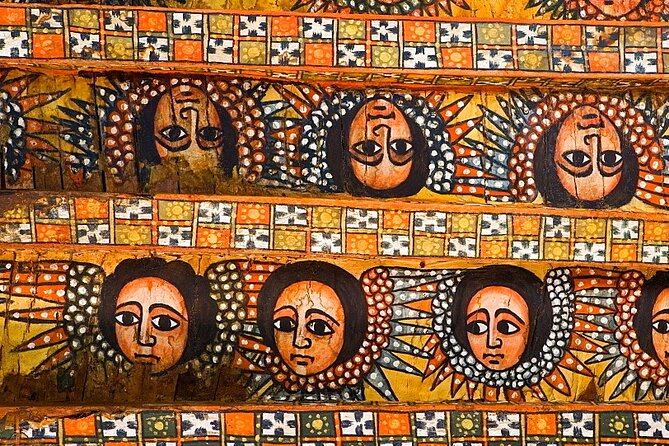
- Debre Birhan Selassie and Gondar’s painted church art
- Wolleka and the memory of Gondar’s Ethiopian Jewish community
- What the $90 price really covers
- Who will get the most from this tour
- Should you book the Gondar city tour?
- FAQ
- Where does the Gondar city tour start?
- What time does the tour begin?
- How long does the experience last?
- Does the tour offer airport or hotel pickup?
- What is included in the price?
- How many people can join the tour?
- Which sites are visited?
- Can I cancel for a full refund?
Four details that shape the day
- Fasil Ghebbi takes the biggest share of your time, with about two and a half hours inside the former royal compound.
- Fasilides Baths are tied to Timkat, when the pool is filled each year for the Ethiopian Orthodox celebration of Epiphany.
- Debre Birhan Selassie is famous for its painted ceiling, guarded by stone towers linked to the apostles and the Lion of Judah.
- Wolleka gives context to Gondar’s Ethiopian Jewish past, but the stop also includes persistent craft sellers.
- Airport and hotel pickup remove a major arrival headache, especially if Gondar is your first stop in the region.
- A maximum of 10 people keeps the outing fairly personal, rather than turning it into a large coach excursion.
Why Gondar deserves a full day
Gondar was founded by Emperor Fasilides in the 1630s and served as the royal capital of Ethiopia for roughly 250 years. That royal role helped revive court life, building, literature, education, music, painting, and trade after the decline of ancient Aksum.
You can see that revival in two very different ways. Fasil Ghebbi gives you stone palaces, fortified walls, churches, and ceremonial spaces. Debre Birhan Selassie gives you religious art that remains part of a living place of worship. The day works best because it does not treat Gondar as a single castle complex. It shows how imperial power, Orthodox Christianity, and local communities shaped the city together.
I would choose this tour for a first visit, particularly if you have only one day in Gondar or want help organizing an airport arrival. It covers the sights most closely linked with the city’s identity, without asking you to arrange separate transport between them.
A few more tours of this kind worth a look:
- 6 Days tour Package (Simien Mountains, Lalibela, and Danakil Depression)
★ 5.0 · 32 reviews - 4 Days Trekking to Simien Mountain National Park
★ 5.0 · 7 reviews - Simien Mountains – 4 Days
★ 4.0 · 7 reviews
Starting at Central Hotel at 9:00 am
The stated meeting point is Central Hotel, at JF69+7RM in Gondar, with the activity ending back there. Pickup is offered, and the package includes an airport or hotel transfer arrangement, but you should make sure your booking clearly states where you want to be collected.
That small check matters if you are landing in Gondar on the morning of the tour. An airport welcome was arranged successfully for one previous booking, which suggests the operator can coordinate this part, but you still want the meeting details settled before departure.
The air-conditioned vehicle is useful in practical terms. Four stops, city roads, and a seven-and-a-half-hour schedule can make a day feel long, so a private-feeling vehicle with cooling is preferable to piecing together taxis. The maximum group size is 10. That is not the same as a private tour, but it should make it easier to hear the guide and ask questions.
The package includes entrance fees as listed in the program, government taxes, airport or departure tax, and a Blue Badge guide. Lunch is not listed among the inclusions. A past booking included lunch, but you should not assume it is part of the $90 price unless the operator confirms it.
Fasil Ghebbi: two and a half hours among royal buildings
Fasil Ghebbi is the core of the day. This former fortress-city covers about 70,000 square meters and is enclosed by a wall roughly 900 meters long. From the outside, it may sound like a single castle. Inside, it is a collection of palaces, churches, monasteries, and public buildings built for an imperial capital.
The compound was the residence of Fasilides and later Ethiopian emperors during the 16th and 17th centuries. Its architecture reflects several influences. Hindu and Arab elements appear alongside the Baroque style introduced by Jesuit missionaries. That combination is one reason Gondar feels different from other historic sites in Ethiopia.
You will have about two and a half hours here, the longest scheduled stop. That is a sensible allocation. The site is large, and a quick walk past one palace would not explain how the royal enclosure functioned as a capital.
The buildings also connect the court to public life. Just south of the enclosure is Adababay, once Gondar’s marketplace and a place for imperial proclamations, troop presentations, and public executions. It is now a city park. That change gives you a useful reminder that the royal compound was not an isolated residence. It was tied to ceremonies, military power, trade, and law.
Fasil Ghebbi is also the stop most likely to reward close attention from your guide. The stones and walls tell only part of the story. Ask how the buildings relate to one another, which spaces were used by the emperor, and how the compound reflected Gondar’s period of renewed artistic and political energy.
The possible downside is simple: two and a half hours can pass quickly. If you want detailed architectural study or careful photography of every structure, you may feel hurried. For a first overview, though, the timing gives the site the attention it deserves.
Fasilides Baths and the annual Timkat connection
The next stop is Fasilides Baths, a quieter site with an important place in Gondar’s religious calendar. The structure is generally linked to Emperor Fasilides or his son Iyasu I, although the exact patron is not known.
The compound includes the bath, a central tower, and a bridge used when the pool is full. Ancient banyan roots have worked their way into the old brick walls, adding a dramatic natural element to the worn masonry. You may find this stop less grand than the royal enclosure, but it helps explain how royal construction later became part of religious practice.
Each year on January 19, the bath is filled for Timkat, the Ethiopian Orthodox celebration of Epiphany. The ceremony recalls the baptism of Christ in the River Jordan. Seeing the site empty is one thing. Knowing how it changes during Timkat gives the pool a much larger meaning than its size might suggest.
The scheduled visit is about one hour, and admission is listed as free. That makes it a good companion to Fasil Ghebbi rather than a costly extra attraction. You will probably want your guide to explain the ceremony, the bridge, and the role of the bath before moving on.
The site may appeal most to you if you care about the connection between royal history and present-day faith. If you prefer a long list of ornate interiors, this will likely be a shorter, more atmospheric stop.
Something different, still within Ethiopia:
- Full Day Tour of Addis Ababa with Hotel Pickup and Drop-off
★ 5.0 · 430 reviews - Taste of Ethiopia
★ 5.0 · 406 reviews - Day Trip From Addis Ababa See Historical Monastery,Stunning Nature,Animals,Birds
★ 5.0 · 303 reviews - Addis Ababa: Debre Libanos, Blue Nile Gorge, and Cave Tour
★ 4.5 · 256 reviews
Debre Birhan Selassie and Gondar’s painted church art
Debre Birhan Selassie Church is scheduled for about two hours, and it is one of the most important stops for anyone interested in Ethiopian religious painting. The name means Trinity and Mountain of Light.
Twelve rounded stone towers surround the church, representing the 12 apostles. A taller 13th tower represents the Lion of Judah, and you may be able to see the lion imprint near the top. These details make the approach itself part of the visit, rather than something to rush through on the way inside.
The present church was rebuilt in the 1880s after the earlier structure was destroyed by a raid from Sudanese Dervishes and a lightning strike. That history gives the building a layered character. What you see today is not untouched 17th-century fabric, but a rebuilt place that carries forward the importance of the earlier church.
The painted interior is the great draw. The original structure was decorated for worshippers who could not read, using images to communicate biblical stories and Christian teaching. The paintings are not simply decoration for a historic monument. They belong to an active religious tradition, so respectful behavior matters.
I would allow time to look upward and absorb the ceiling rather than treating the church as a quick photo stop. Your guide can help you read the images and explain the figures. Since the tour includes a Blue Badge guide and admission, this is where having someone to interpret the art adds real value.
Photography rules and conditions inside religious buildings can vary. Follow the guide’s instructions and keep your visit quiet. The church may be the emotional high point of the day, but it is also the place where a rushed group can feel most intrusive.
Wolleka and the memory of Gondar’s Ethiopian Jewish community
Wolleka, also known as the Falasha Village, gives the itinerary a different focus. The area was once home to a thriving Ethiopian Jewish population. Most residents were airlifted to Israel in the 1980s, and the community no longer remains there in the same form.
A few original houses survive, with artwork on their fronts, and there is a small synagogue. A small fee of 10 birr may allow you to look inside. The stop is useful because it adds a social and religious chapter to Gondar’s story, one that can be missed if you visit only royal and Orthodox Christian sites.
The community faced severe pressure after Christianity became the state religion. Land was confiscated from those who refused to convert, and many Ethiopian Jews supported themselves through skilled crafts. Research suggests they may have provided labor for building and decorating parts of Gondar, including the royal compound.
You should approach this stop with realistic expectations. Wolleka is not presented as a fully preserved historic village, and the Ethiopian Jewish community is no longer based there. Some stalls use Stars of David and Falasha Village signs to attract attention, while persistent children may try to sell crafts or encourage purchases.
That commercial pressure can make the visit uncomfortable. You can look, ask questions, and decide for yourself if you want to buy something. Do not feel obliged simply because a seller follows you. The value of Wolleka is the context it adds, not the number of souvenirs you take home.
What the $90 price really covers
At $90 per person, this tour is not the cheapest way to walk around Gondar, but the price includes several services that are easy to underestimate. You are paying for a vehicle, pickup assistance, entrance fees listed in the program, taxes, and a guide over most of a full day.
The strongest value comes if you are arriving by air, staying near the stated meeting point, or do not want to negotiate transport between four sites. Airport coordination can be especially helpful after a flight, when a clear welcome and a waiting vehicle save time and stress.
The price is less compelling if you already have a car, a trusted local guide, and plenty of time in Gondar. In that case, arranging individual visits could give you more control over how long you spend at Fasil Ghebbi or Debre Birhan Selassie.
Still, the schedule is well chosen for a first introduction. The tour does not spend the entire day at one palace. It balances imperial architecture, religious art, a ceremonial bath, and the memory of a historic Jewish community.
Who will get the most from this tour
I would recommend it to you if you want a clear first look at Gondar and prefer having the day arranged. It suits people with limited time, first-time visitors, and anyone who wants airport pickup combined with sightseeing.
It is also a good fit if church art interests you. Debre Birhan Selassie deserves patient attention, and the guide can explain images and symbols that are easy to miss without context.
Families and small groups may appreciate the maximum of 10 people, along with the air-conditioned vehicle. Most people can participate, according to the tour information, but the day still includes walking around historic compounds and outdoor sites. You should be comfortable moving between these locations.
I would hesitate to recommend it to you if your main goal is a slow photographic study. The itinerary has four stops in 7.5 hours, so the structure favors coverage over long, unplanned pauses. It may also disappoint you if you expect Wolleka to function as a preserved village with a large resident community.
The cancellation terms are generous if your plans change: cancel at least 24 hours before the 9:00 am start for a full refund. Changes or cancellations inside that 24-hour window are not refunded, and the experience requires a minimum number of participants. If the operator cancels for that reason, you are offered another date or experience, or a full refund.
Should you book the Gondar city tour?
Book it if you want the city’s essential historic and religious sights handled in one day, especially with airport or hotel pickup. Fasil Ghebbi and Debre Birhan Selassie justify the outing on their own, while Fasilides Baths and Wolleka give the day added depth.
The best reason to choose this experience is organization. Mickey’s airport coordination and connection with local guides show the practical help the operator can provide, and the $90 cost covers more than a simple guided walk.
Before paying, confirm your pickup point, ask whether lunch is included for your date, and be ready for a fairly full schedule. If you accept those limits, this is a strong introduction to Gondar, with enough variety to show why the city became Ethiopia’s imperial capital.
FAQ
Where does the Gondar city tour start?
The stated meeting point is Central Hotel, ሴንትራል ሆቴል, in Gondar, Ethiopia.
What time does the tour begin?
The tour starts at 9:00 am.
How long does the experience last?
The approximate duration is 7 hours and 30 minutes.
Does the tour offer airport or hotel pickup?
Yes. Pickup is offered, including airport and hotel pickup arrangements. Confirm the exact collection point when booking.
What is included in the price?
The price includes an air-conditioned vehicle, airport or departure tax, a Blue Badge guide, entrance fees according to the program, and government taxes.
How many people can join the tour?
The activity has a maximum group size of 10 people.
Which sites are visited?
The itinerary includes Fasil Ghebbi, Fasilides Baths, Debre Birhan Selassie Church, and Wolleka, also called Falasha Village.
Can I cancel for a full refund?
Yes. You must cancel at least 24 hours before the experience start time for a full refund. Cancellations or changes made within 24 hours are not refunded.
Just added around Ethiopia
- 10 Days in Northern Ethiopia Tours★ 4.5 · 3 reviews
- Lalibela 2-Day Eco Trekking Tour★ 5.0 · 3 reviews
- Day trek to Simeien Mountains★ 5.0 · 3 reviews
- Full Day Tour in Lalibela★ 5.0 · 3 reviews
- Day Trip to Tiya UNESCO Site & Melka Kunture Archaeological Site★ 4.5 · 3 reviews
- Two days Lake Wenchi and Menagesha Forest★ 5.0 · 3 reviews
- 4 Days tour in omo valley.★ 4.5 · 3 reviews
- 6 days 5 nights Addis Abeba sightseeing & Lalibela Rock-Hewn Churches★ 5.0 · 3 reviews
City Tours, compared.
Addis Ababa Guided City Tour With Airport & Hotel Pick Up
Read our review →
Authentic Addis Ababa City Tour with a Local Guide
Read our review →
Browse the lists this tour appears in