
Reviewed · CITY TOURS
Full-Day Private City Tour of Addis Ababa
Addis Ababa rewards a flexible plan. This private full-day tour combines major museums, historic churches, Entoto Hill, Mercato Market, and a home-style Ethiopian coffee ceremony, all with private transportation and a guide who can adjust the day to your interests. I especially like the private format, which lets you spend more time at the places that matter to you, and the chance to share coffee and lunch with a local family rather than seeing the city only through museum glass.
The main consideration is the pace. Seven to nine hours is a lot of sightseeing, and the suggested route includes several churches, two museums, a market, a mountain visit, and Meskel Square. Entrance fees are also extra at three stops, and the National Museum was temporarily closed from December 19, 2024, so you should confirm its status before booking.
In This Review
- Key points at a glance
- Why this is a useful first day in Addis Ababa
- St. George’s Cathedral and the story in its walls
- Entoto Hill at 3,200 meters
- Mercato, where a guide earns the fee
- The Ethnological Museum in a former palace setting
- Lucy and Ethiopia’s place in human evolution
- Holy Trinity Cathedral and imperial memory
- Meskel Square and the city’s public center
- What the $160 price really gives you
- Timing, transport, and the day’s tradeoffs
- Who should book this Addis Ababa tour?
- Should you book it?
- FAQ
- How long does the Addis Ababa city tour last?
- How many people can join the private tour?
- Is hotel or airport pickup included?
- Is transportation provided during the tour?
- Are entrance fees included?
- Is lunch included?
- Is the Ethiopian coffee ceremony included?
- Is Mercato Market open every day?
- Can the itinerary be changed?
Key points at a glance
- A private group experience for up to six people: You get your own guide, driver, vehicle, and itinerary rather than joining strangers.
- Entoto Hill reaches about 3,200 meters: The eucalyptus drive leads to broad views over Addis Ababa, with options for a walk, church visit, palace visit, or market stop.
- The coffee ceremony is a real cultural highlight: A local family visit includes traditional coffee, home-cooked Ethiopian food, and local hospitality.
- Mercato requires a guide: The market is large, crowded, and full of specialized sections, so local help makes bargaining and finding the right areas easier.
- The day links Ethiopia’s past and present: Lucy, the Battle of Adwa, Emperor Haile Selassie, Orthodox Christianity, contemporary art, food, and daily commerce all appear along the route.
- The price works best for a small group: At $160 per group, six people pay about $26.67 each before entrance fees, while a solo visitor pays the full amount.
Why this is a useful first day in Addis Ababa

Addis Ababa is spread out, busy, and not always easy to read at first glance. A private vehicle saves you from sorting out transport between distant sights, while an English-speaking guide provides the context that makes those sights meaningful.
The route also gives you several different versions of the city. You move from imperial churches and national museums to a high mountain forest, a huge open-air market, and a family coffee ceremony. That mix is more useful than spending the whole day on monuments alone.
The private setup is especially helpful if you have only one day in Addis Ababa or a long layover. Pickup and drop-off are offered at your hotel or the airport, and the schedule can be shaped around your interests. Several guides have received especially warm praise for their patience and flexibility, including Biruk, Henok, Abenezer, Wondiye, and Muluken. Solomon has also guided the tour in Spanish.
I would still contact the operator before the day begins and identify your priorities. If Lucy matters most, say so. If you prefer markets and local life to museums, ask for more time at Mercato or Entoto. The route is ambitious, and a private tour is most valuable when you use that flexibility.
More full-day trips:
- Full Day Tour of Addis Ababa with Hotel Pickup and Drop-off
★ 5.0 · 430 reviews - Addis Ababa City Tours Full Day With Hotel Pickup And Drop Off.
★ 5.0 · 51 reviews - Best of Addis Ababa- (full day)
★ 5.0 · 37 reviews
St. George’s Cathedral and the story in its walls
The first major stop is St. George’s Cathedral, one of Addis Ababa’s oldest religious sites. Its octagonal shape makes it easy to recognize, but the interior is the real reason to visit.
Inside, you can see mosaics showing biblical scenes, including the meeting of the Queen of Sheba and King Solomon. Hand-painted scenes also connect the church to Emperor Haile Selassie and the Ethio-Italian War. The work of Ethiopian artist Afework Tekle gives the visit an artistic focus, not just a religious one.
Allow about 45 minutes here. The small museum adds historical and religious objects, but admission is not included and costs about $3. You should dress and behave respectfully, since this remains an important place of worship, not simply a sightseeing stop.
The drive afterward passes central streets and historic monuments, including the Lion of Judah. This short riding section helps connect the cathedral to the wider story of the capital and gives your guide room to explain what you are seeing between stops.
Entoto Hill at 3,200 meters
Entoto is one of the day’s strongest stops. You climb through eucalyptus forest to an elevation of roughly 3,200 meters, then look down over Addis Ababa from above. The air and scenery offer a sharp change from the traffic and concrete below.
The view is weather-dependent, so do not treat it as guaranteed. The altitude may also make walking feel harder than expected. Take your time, especially if you have just arrived in Ethiopia or are not used to high elevations.
The tour allows several choices here:
- Walk in Entoto Park
- Visit Entoto Maryam Church
- See the palace associated with Emperor Menelik II
- Walk through a nearby village
- Visit Shiro Meda, also called Chiromeda, Market
The market sells textiles, spices, pottery, woven baskets, jewelry, crafts, and souvenirs. It is a good place to look for gifts that feel connected to Ethiopia rather than generic airport purchases. Your guide can help with bargaining, which is a normal part of trading at Mercato and other markets, while also helping you keep the exchange friendly and fair.
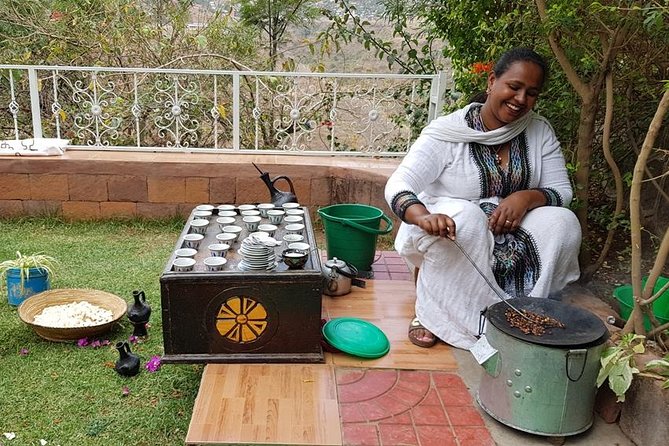
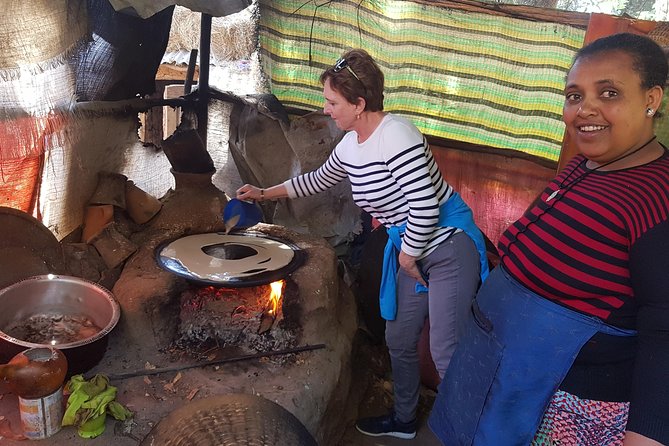
The most personal part of Entoto is the local family visit and coffee ceremony. Ethiopian coffee is not treated as a quick caffeine stop. You can watch the preparation and roasting, drink the coffee, and share food in a home setting. Several people who took this tour singled out the coffee ceremony and lunch as the day’s favorite moments, partly because the atmosphere felt informal and welcoming.
Local snacks, coffee, tea, and a home-cooked Ethiopian lunch are included. Some experiences also include local honey wine, according to the tour description and guest accounts, but I would confirm whether it is part of your specific visit. This portion gives you something a museum cannot: a direct connection with everyday hospitality.
Mercato, where a guide earns the fee
Mercato is described as the biggest market in Africa, and the important point for you is its scale. It is not one tidy street lined with souvenir shops. It is a collection of market sections with different goods, foods, spices, crafts, and household products.
The visit lasts about an hour. Your guide walks with you through the more scenic and culturally interesting sections, including places selling ingredients for Ethiopian cooking and false banana tree bread. You can also look for handwoven clothing, grass baskets, and other locally made items.
Bargaining is expected. If you are unused to it, let your guide show you how to begin, what a reasonable exchange feels like, and when to walk away. The guide also helps you stay focused in a crowded setting, where it is easy to lose time or become overwhelmed.
Mercato is closed on Sundays, so avoid scheduling this tour that day if the market is important to you. The stop may also be less comfortable for anyone who dislikes crowds or prefers quiet, polished shopping. I see that as a question of travel style, not a flaw. Mercato offers a side of Addis Ababa that formal attractions cannot reproduce.
A few more tours of this kind worth a look:
- Taste of Ethiopia
★ 5.0 · 406 reviews - Day Trip From Addis Ababa See Historical Monastery,Stunning Nature,Animals,Birds
★ 5.0 · 303 reviews - Addis Ababa: Debre Libanos, Blue Nile Gorge, and Cave Tour
★ 4.5 · 256 reviews - Addis Ababa Guided City Tour With Airport & Hotel Pick Up
★ 5.0 · 237 reviews
The Ethnological Museum in a former palace setting
The Ethnological Museum occupies part of the Addis Ababa University compound and is one of the day’s best stops for understanding Ethiopia’s many peoples and traditions. A guided visit takes about an hour.
The ground floor includes an exhibition on Ethiopia’s victory over Italy at the Battle of Adwa in 1896. Another room honors Ethiopian poets, writers, and translators. These displays give useful background before you reach the main collection upstairs.
The first floor presents objects and information connected with different ethnic groups in Ethiopia. You can expect a broad look at clothing, customs, domestic life, and cultural traditions. The value here is not simply seeing objects. Your guide can explain how they connect to the people who made and used them.
Admission is extra, about $2. The museum adds structure to the day after the open-air experience at Mercato, though visitors who are mainly interested in street life may find an hour indoors demanding after a full morning of sightseeing.
Lucy and Ethiopia’s place in human evolution
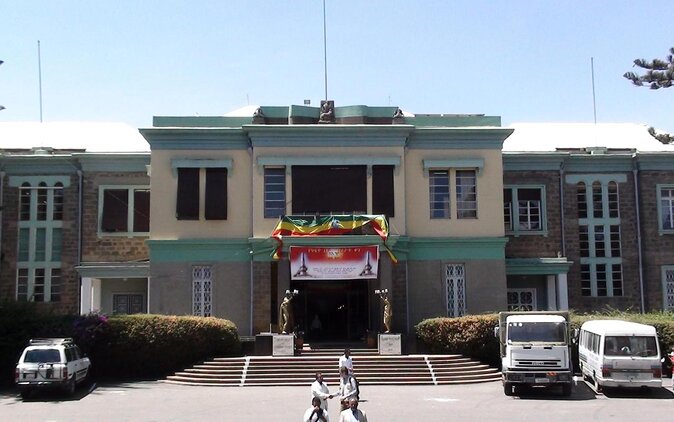
The National Museum of Ethiopia shifts the focus from national culture to human origins. Its most famous object is Lucy, the 3.2-million-year-old Australopithecus afarensis fossil.
You can also see sections on the Aksumite Empire, Ethiopian Orthodox Christianity, and modern Ethiopian history. The upper floor presents Ethiopian art, from older religious paintings and sculptures to contemporary works.
This is the museum I would prioritize if you have never visited Addis Ababa. Lucy is the headline, but the wider collection helps you understand why Ethiopia is so important to the study of human evolution and African history.
Admission is included, unlike the three other paid attractions. However, the museum was temporarily closed from December 19, 2024. Because opening conditions can change, confirm that it is operating before you rely on this part of the route. If it is unavailable, the private format should make it easier to spend longer elsewhere.
Holy Trinity Cathedral and imperial memory

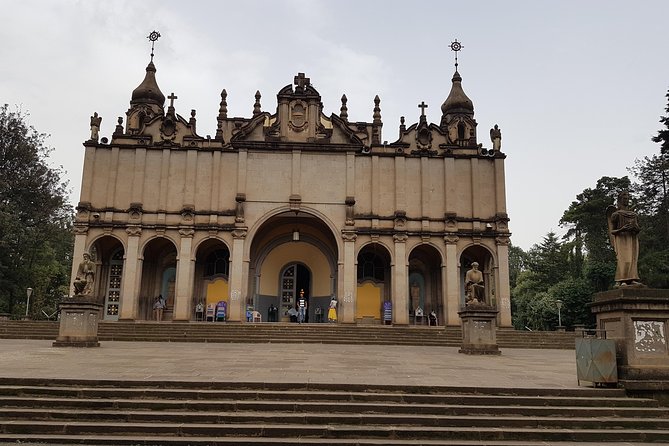
Holy Trinity Cathedral is among Addis Ababa’s most important religious sites. Emperor Haile Selassie commissioned it in 1944, and it is the burial place of Haile Selassie and other prominent Ethiopians.
The cathedral’s stained-glass windows show biblical stories. A particularly significant painting depicts Haile Selassie addressing the League of Nations in 1936, when he appealed for international help against the Italian invasion. That image links the church to Ethiopia’s modern political story.
A small museum contains religious clothing, royal items, and historical objects. The cathedral and museum together take about an hour, and a guide helps you understand details you might otherwise pass without noticing.
Admission costs about $12 and is not included. That fee is much higher than the charges at St. George’s Cathedral and the Ethnological Museum, so budget for it. Even so, this is a worthwhile stop if you want to understand Ethiopia’s monarchy, Orthodox faith, and 20th-century politics in one place.
As at St. George’s, respectful clothing and behavior are important. This is an active religious site and a burial place, not just a historic building.
Meskel Square and the city’s public center
The final stop is Meskel Square, the main square in Addis Ababa. It is named for Meskel, the Ethiopian Orthodox celebration connected with the finding of the True Cross.
The stop lasts about 10 minutes, so think of it as a brief orientation point rather than a full attraction. Your guide can explain the square’s role in city life and the religious event behind its name. After a long day, this short pause is welcome.
What the $160 price really gives you
The tour costs $160 per group of up to six people. That includes a private air-conditioned vehicle, an English-speaking guide, a tour escort or host, hotel or airport pickup and drop-off, bottled water, snacks, coffee, tea, the coffee ceremony, and lunch.
For six people, the base cost comes to about $26.67 per person. That is strong value for a full day of private transport and guiding. For two people, the cost is $80 each before entrance fees, which is still reasonable if you value convenience and personal attention. For one person, it becomes a more serious expense.
Plan for roughly $17 in additional admission fees if all three paid sites are open: about $12 for Holy Trinity Cathedral, $3 for St. George’s Cathedral, and $2 for the Ethnological Museum. The National Museum admission is included.
The included lunch and family coffee ceremony improve the value. You are not paying only to sit in a vehicle and check off landmarks. You are also receiving a cultural exchange that would be difficult to arrange alone.
Timing, transport, and the day’s tradeoffs
Seven to nine hours gives you time to cover a lot of ground, but traffic can affect the rhythm. The private vehicle is more than a comfort feature. It makes the route possible without spending much of the day arranging rides.
The itinerary includes about 45 minutes at St. George’s, two hours around Entoto and Shiro Meda, and about an hour each at Mercato, the Ethnological Museum, the National Museum, and Holy Trinity Cathedral. Meskel Square adds a short final stop. Actual timing can shift because the tour is private and flexible.
That flexibility is a major advantage. You can ask to spend longer at Lucy, shorten a museum, add a walk, or focus on shopping. The tradeoff is that you need to communicate clearly. If you try to do every optional activity in full, the day may feel packed.
The tour is suitable for most people, and confirmation is provided when you book. Airport pickup makes it practical for a layover, but you should leave enough time for your onward flight. The operator offers free cancellation up to 24 hours before the start time. Changes or cancellations inside that window are not accepted for a refund.
Who should book this Addis Ababa tour?
I would choose this experience if you are visiting Addis Ababa for the first time, have one free day, or are passing through on a long layover. It suits small families and friend groups particularly well because the $160 price is shared across the group.
It is also a good fit if you want both major sights and personal contact. The museums and cathedrals provide structure, while the coffee ceremony, market walk, and village visit offer a closer look at local life.
You may want something else if you prefer a slow museum day, dislike busy markets, or want to explore entirely on foot. The distance between stops and the number of attractions make private transport useful, but this is not a leisurely single-neighborhood walk.
Should you book it?
Book this tour if you want a broad, practical introduction to Addis Ababa and value having the day shaped around you. The strongest parts are the private vehicle, flexible guides such as Biruk, Henok, Abenezer, and Wondiye, the Entoto views, and the family coffee ceremony with lunch.
Before booking, confirm the National Museum’s current opening status, check that your date is not a Sunday if Mercato matters, and set aside the extra cathedral fees. If you have only one day in the capital, this tour gives you a useful first look at Ethiopia’s faith, art, politics, food, markets, and daily life without forcing you into a fixed group schedule.
FAQ
How long does the Addis Ababa city tour last?
The tour lasts approximately seven to nine hours.
How many people can join the private tour?
The price covers one private group of up to six people.
Is hotel or airport pickup included?
Yes. Hotel and airport pickup and drop-off are included with private air-conditioned transportation.
Is transportation provided during the tour?
Yes. The tour includes a private air-conditioned vehicle, driver, guide, and tour escort or host.
Are entrance fees included?
Most entrance fees are not included. You should expect extra charges of about $12 at Holy Trinity Cathedral, $3 at St. George’s Cathedral, and $2 at the Ethnological Museum. Admission to the National Museum is included.
Is lunch included?
Yes. Home-cooked Ethiopian meals are included, along with bottled water, local snacks, coffee, and tea.
Is the Ethiopian coffee ceremony included?
Yes. Attendance at a traditional Ethiopian coffee ceremony is included, and it takes place during the local family visit.
Is Mercato Market open every day?
Mercato Market is closed on Sundays.
Can the itinerary be changed?
Yes. This is a private tour with a flexible itinerary, so you can tailor the stops and timing to your interests.
Just added around Addis Ababa
- 10 Days in Northern Ethiopia Tours★ 4.5 · 3 reviews
- Day Trip to Tiya UNESCO Site & Melka Kunture Archaeological Site★ 4.5 · 3 reviews
- Two days Lake Wenchi and Menagesha Forest★ 5.0 · 3 reviews
- 6 days 5 nights Addis Abeba sightseeing & Lalibela Rock-Hewn Churches★ 5.0 · 3 reviews
- Addis Ababa Half Day Shopping Tour★ 5.0 · 3 reviews
- 6 days Omo valley cultural Tour★ 5.0 · 3 reviews
- 12- Day Historical Route of Ethiopia★ 5.0 · 3 reviews
- Addis Ababa City Tour★ 4.5 · 3 reviews
City Tours, compared.
Addis Ababa Guided City Tour With Airport & Hotel Pick Up
Read our review →
Authentic Addis Ababa City Tour with a Local Guide
Read our review →


Addis Ababa City Tours Full Day With Hotel Pickup And Drop Off.
Read our review →Browse the lists this tour appears in